

Design turns visual taste into working rules
The product describes this Brand Kit section as:Your brand’s visual design language, colors, typography, and components.Design is a single markdown document rather than a form. Preview shows it as a readable design system, while Edit exposes the markdown behind it. The document opens with an Overview of how the brand looks and why, then records its Key Characteristics. This is your written brand system. It gives the agent a coherent set of rules instead of leaving each visual decision open to interpretation.
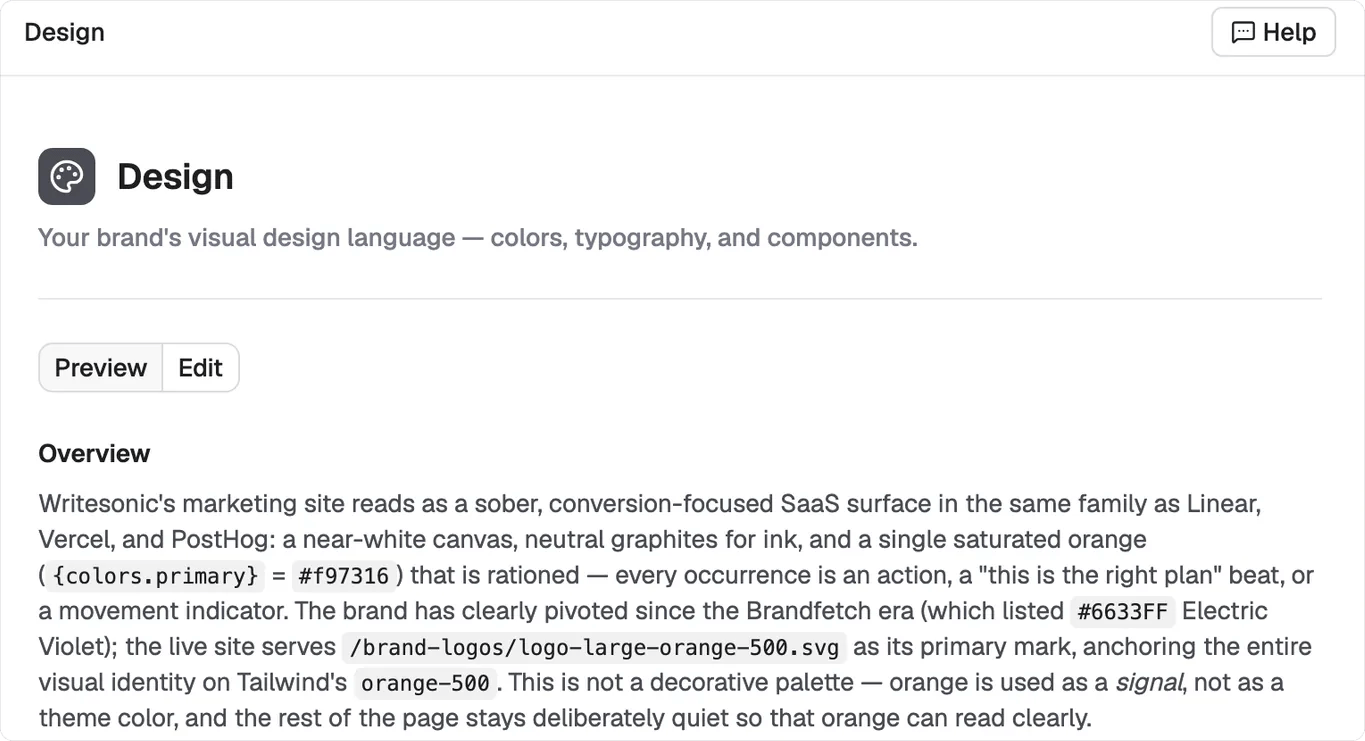
The Design section records the brand's visual system in a markdown document with Preview and Edit views.
Live tokens keep visual details exact
Design carries live design tokens and asset paths alongside the explanations. A primary color can be recorded as a token, while the logo can be recorded as a file path. That distinction matters. The agent can use the actual hex and the actual mark instead of approximating either from a description. Typography and spacing follow the same pattern. The document can preserve the type stack and the allowed section padding range, giving the agent usable values for its visual decisions.Intent tells the agent when to hold back
Values alone don’t explain how a system should feel in use. In one real Design document, the brand’s orange is rationed and used as a signal rather than a theme color. The rest of the page stays quiet so the content reads clearly. That rule does more work than the color value alone because it tells the agent where orange belongs, how often it should appear, and why generated assets shouldn’t become loud.The Design agent works from one grounded system
The Design agent is grounded in this document once, then makes visual decisions from it. Like the rest of the agent team, it uses shared context to keep its work aligned with your company. The document becomes the reference point for color, typography, spacing, assets, and visual restraint.Design sets direction without rendering your site
Design describes the system in words, tokens, and asset paths. It isn’t a component library, and it doesn’t render your site. Its job is narrower. It gives the Design agent the materials and rules needed to make brand-specific visual choices.What’s next
The agent team
See how specialist agents work from shared context.
Brand Kit
Set up the context every agent works from.