

Every place context can live has a different lifetime
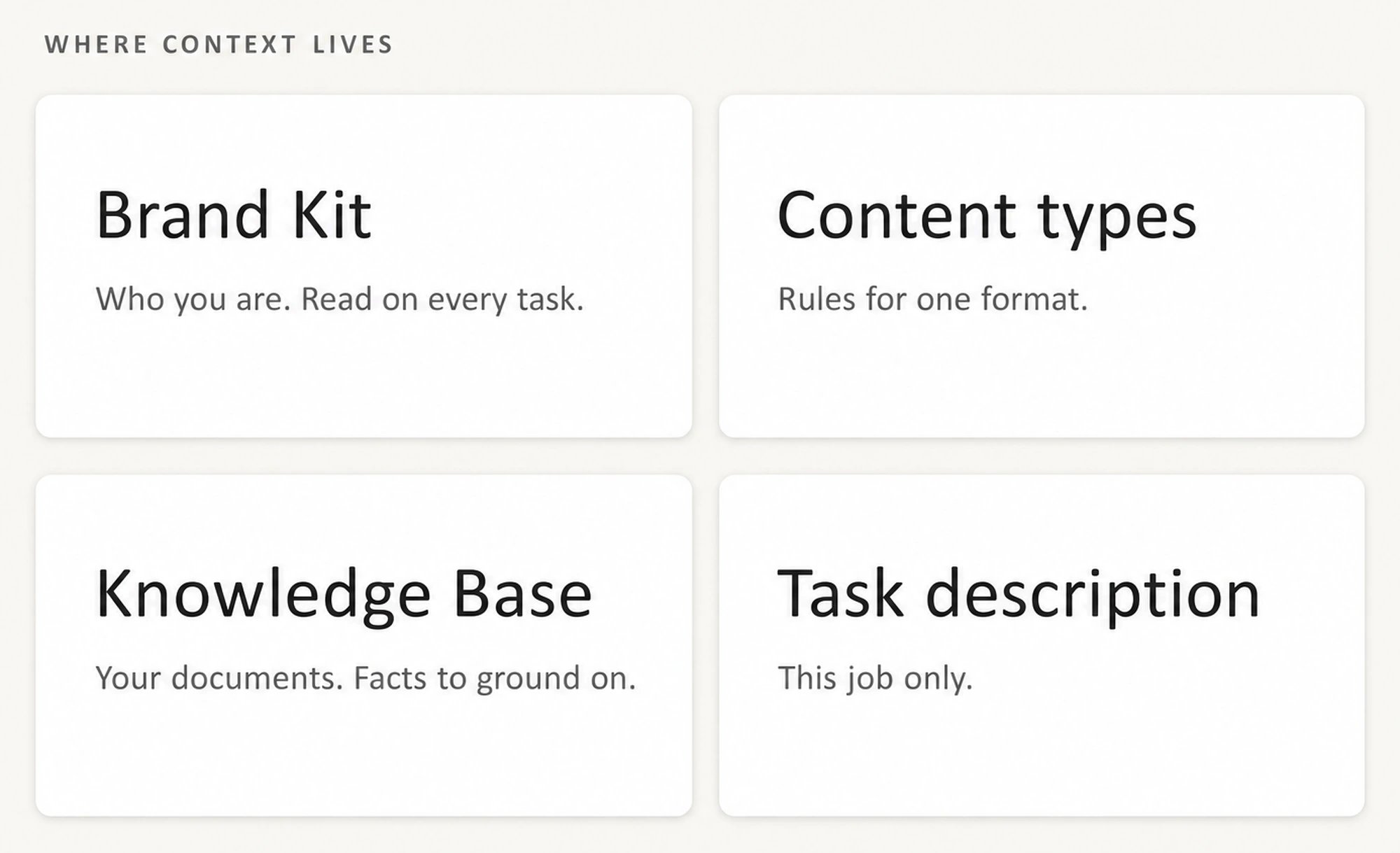
Each place has its own lifetime. The Brand Kit is read on every task. A task description is read once.
Each place matches a different lifetime
The Knowledge Base holds documents, not rules
The Knowledge Base holds your own documents so agents can ground their work in them. Use it for source material and facts. Voice, formatting and standing instructions belong in the Brand Kit instead.Standing rules belong in the Brand Kit
Never mention a competitor by name is a standing company rule, so put it in the Brand Kit. Every agent reads the Brand Kit on every task. If you keep pasting that instruction into task descriptions, its lifetime is wrong. The rule disappears when the task ends, and someone has to remember it next time.
A company-wide rule you repeat per task belongs in the Brand Kit.
What’s next
Set up your Brand Kit
Work through the six sections.
Writing good tasks
Learn what to put in a task description.