> ## Documentation Index
> Fetch the complete documentation index at: https://apidocs.writesonic.com/llms.txt
> Use this file to discover all available pages before exploring further.
# AI Search Basics: What It Is & How It Works
## What is AI Search?
If you're here, you've probably noticed something: AI is changing how people find information online. Let's understand what's actually happening under the hood.
### How People Search Has Changed
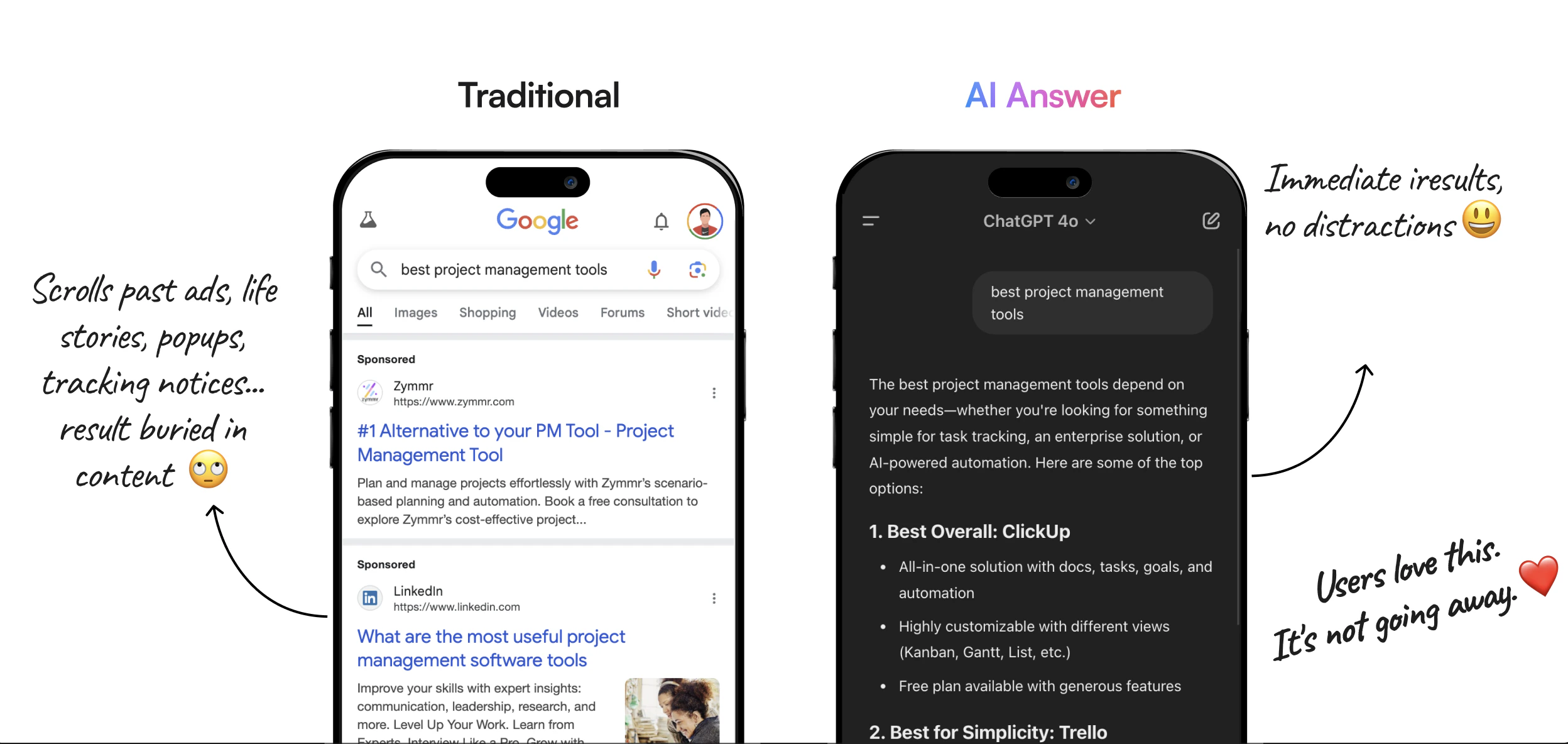 **Traditional Google Search:**
* User types keywords: "CRM software" (2-3 words)
* Google shows 10 blue links
* User clicks one
* You track the visit
**AI Search:**
* User asks: "What's the best CRM for a 10-person remote marketing team that integrates with Slack?"
* AI reads multiple sources
* Creates one synthesized answer
* Maybe mentions you, maybe doesn't
* You might never know
**Traditional Google Search:**
* User types keywords: "CRM software" (2-3 words)
* Google shows 10 blue links
* User clicks one
* You track the visit
**AI Search:**
* User asks: "What's the best CRM for a 10-person remote marketing team that integrates with Slack?"
* AI reads multiple sources
* Creates one synthesized answer
* Maybe mentions you, maybe doesn't
* You might never know
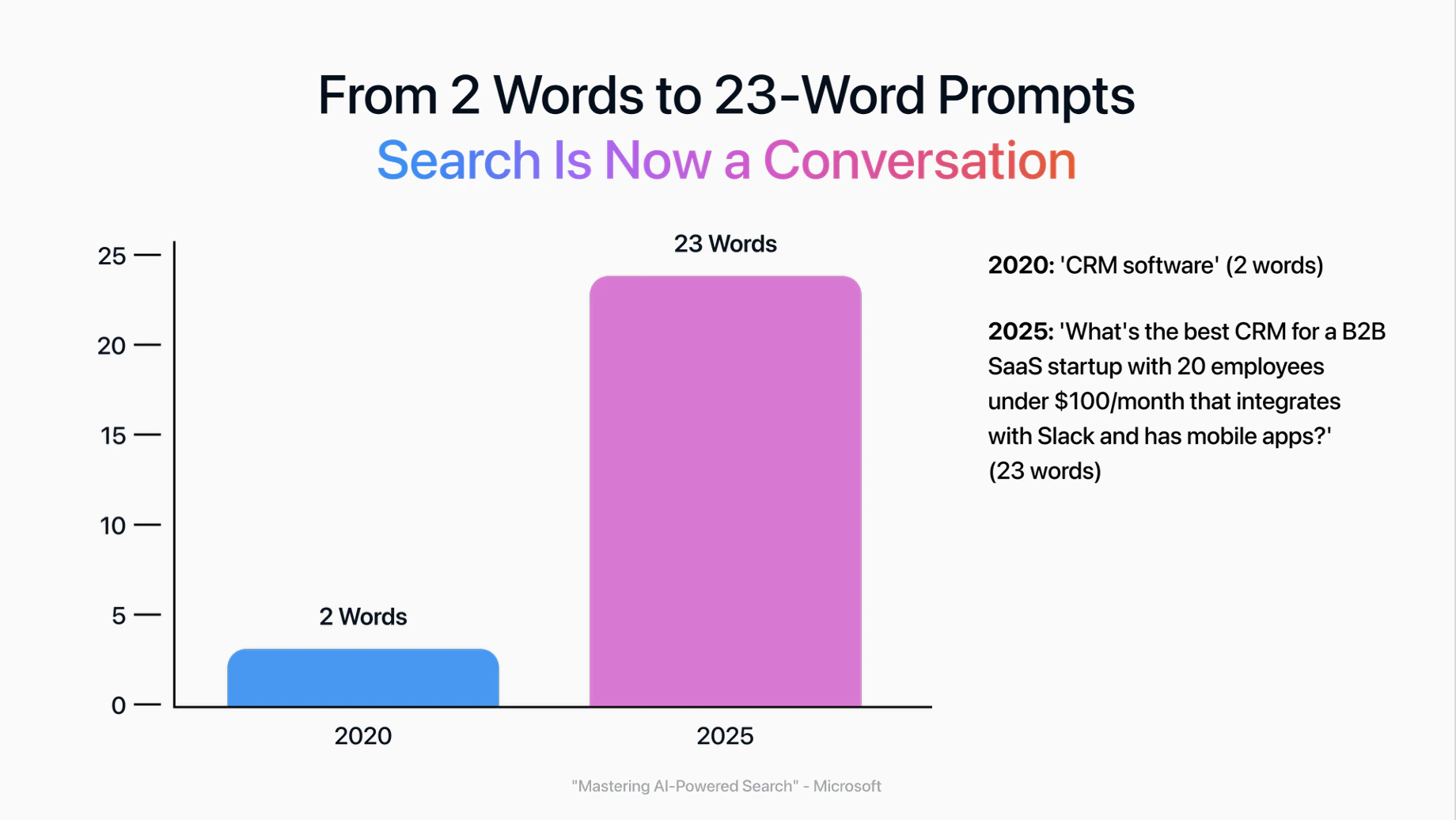 People don't type keywords anymore. They have conversations. They provide context. They expect personalized answers.
## How AI Search Actually Works (RAG)
People don't type keywords anymore. They have conversations. They provide context. They expect personalized answers.
## How AI Search Actually Works (RAG)
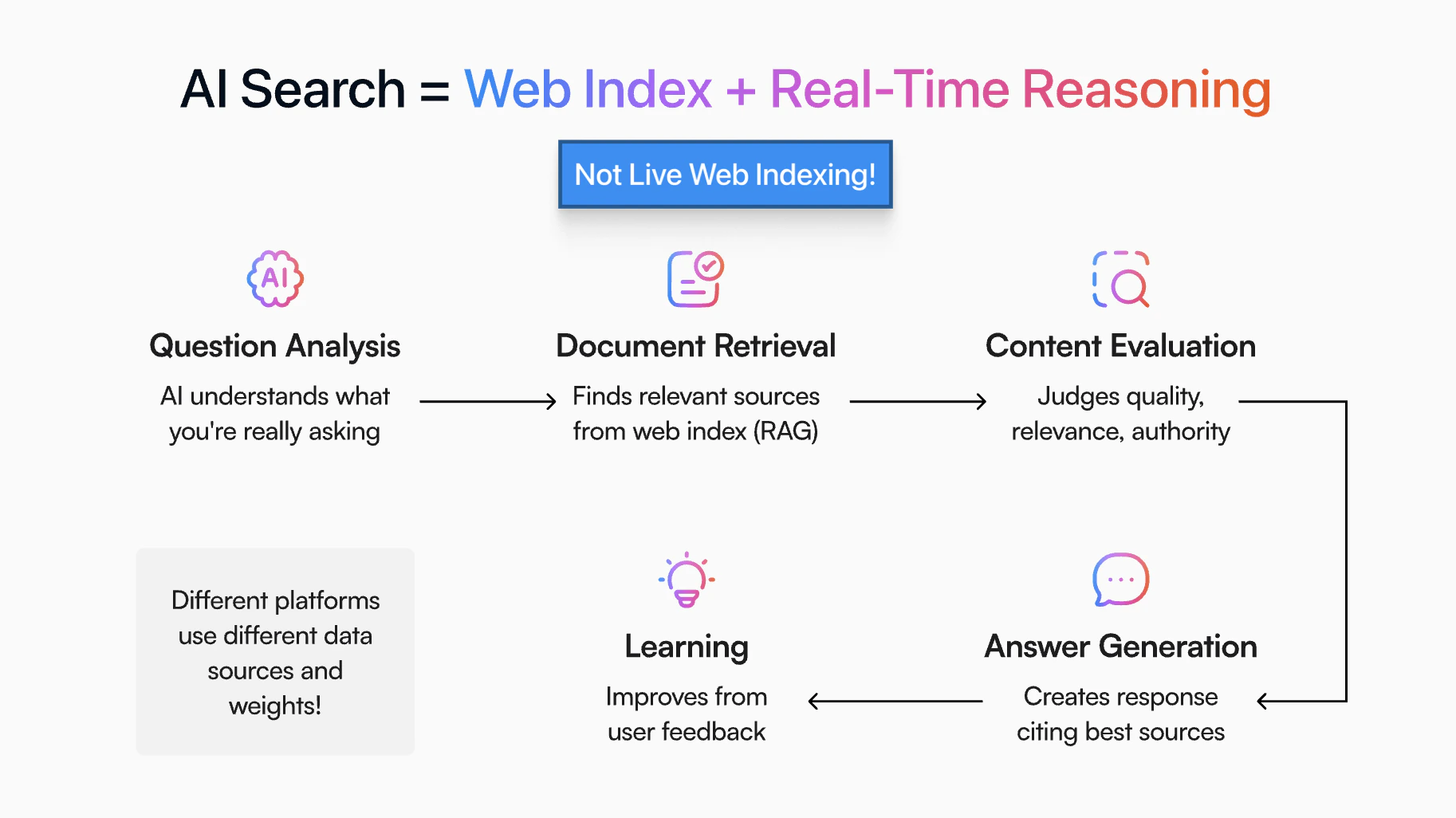 AI search uses Retrieval Augmented Generation (RAG) to provide answers.
Here's what happens step by step:
**1. Question Analysis**
* AI understands what you're really asking
* Identifies key entities, intent, and context
* Expands the question to capture related concepts
**2. Document Retrieval**
* Searches pre-built web indexes (not the live web!)
* Uses vector search to find semantically similar content
* Retrieves relevant passages from multiple sources
**3. Content Evaluation**
* Judges quality, relevance, and authority of sources
* Filters out low-quality or outdated information
* Prioritizes trusted domains and recent content
**4. Answer Generation**
* Synthesizes information from selected sources
* Creates coherent response in natural language
* Decides whether to include citations (usually doesn't)
**5. Learning**
* Improves from user feedback and interactions (remember the thumbs up/down buttons next to ChatGPT answers?)
* Adjusts ranking and selection algorithms
* Updates understanding of what makes good answers
AI search uses Retrieval Augmented Generation (RAG) to provide answers.
Here's what happens step by step:
**1. Question Analysis**
* AI understands what you're really asking
* Identifies key entities, intent, and context
* Expands the question to capture related concepts
**2. Document Retrieval**
* Searches pre-built web indexes (not the live web!)
* Uses vector search to find semantically similar content
* Retrieves relevant passages from multiple sources
**3. Content Evaluation**
* Judges quality, relevance, and authority of sources
* Filters out low-quality or outdated information
* Prioritizes trusted domains and recent content
**4. Answer Generation**
* Synthesizes information from selected sources
* Creates coherent response in natural language
* Decides whether to include citations (usually doesn't)
**5. Learning**
* Improves from user feedback and interactions (remember the thumbs up/down buttons next to ChatGPT answers?)
* Adjusts ranking and selection algorithms
* Updates understanding of what makes good answers
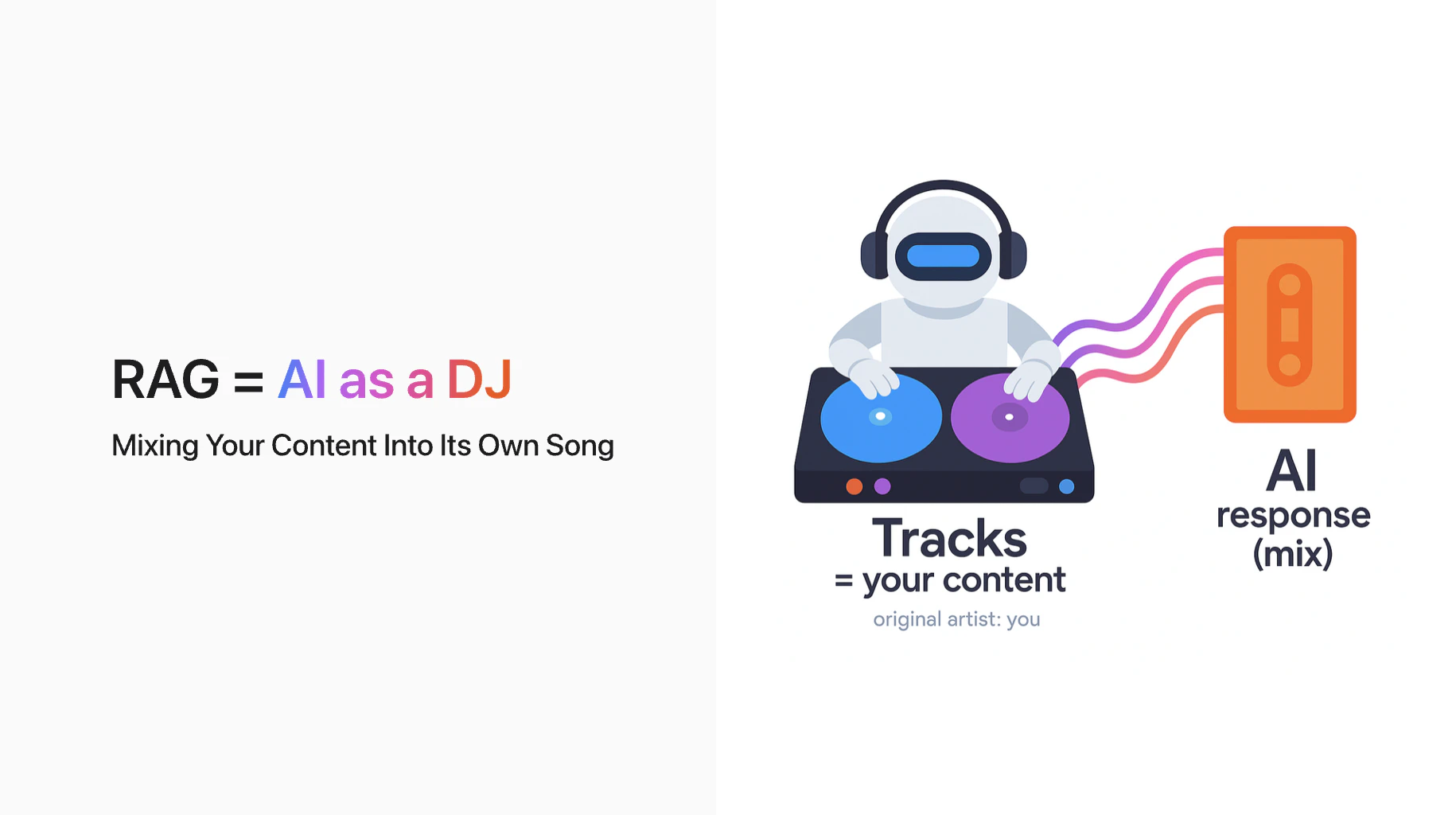 Think of it like a DJ mixing tracks - AI pulls content from different sites and mixes it into one answer. But most of the time, it forgets to credit the original artists.
### Where AI Gets Its Information
**Critical insight:** AI doesn't crawl the live web. Each platform uses different pre-built indexes:
| Platform | Index Source |
| ------------------- | ------------------ |
| ChatGPT | Bing + proprietary |
| Perplexity | Google's index |
| Claude | Own crawled data |
| Google AI Overviews | Google's index |
| Gemini | Google's index |
This means your brand new content won't appear immediately - it needs to be indexed first by the underlying search engine.
### Google's Query Fan-Out Method
Think of it like a DJ mixing tracks - AI pulls content from different sites and mixes it into one answer. But most of the time, it forgets to credit the original artists.
### Where AI Gets Its Information
**Critical insight:** AI doesn't crawl the live web. Each platform uses different pre-built indexes:
| Platform | Index Source |
| ------------------- | ------------------ |
| ChatGPT | Bing + proprietary |
| Perplexity | Google's index |
| Claude | Own crawled data |
| Google AI Overviews | Google's index |
| Gemini | Google's index |
This means your brand new content won't appear immediately - it needs to be indexed first by the underlying search engine.
### Google's Query Fan-Out Method
 Google AI Overviews and the upcoming AI Mode do something unique - they expand one query into many.
When someone searches "best CRM software," Google AI generates 20+ related searches behind the scenes:
* CRM pricing comparison
* CRM features for small teams
* CRM integration capabilities
* CRM user reviews
* CRM setup complexity
* CRM customer support quality
Your content ranking #50 for the main term might rank #2 for "CRM API capabilities" and get included. This is why comprehensive content wins - you need to match the entire query universe, not just one keyword.
### When AI Decides to Search
Google AI Overviews and the upcoming AI Mode do something unique - they expand one query into many.
When someone searches "best CRM software," Google AI generates 20+ related searches behind the scenes:
* CRM pricing comparison
* CRM features for small teams
* CRM integration capabilities
* CRM user reviews
* CRM setup complexity
* CRM customer support quality
Your content ranking #50 for the main term might rank #2 for "CRM API capabilities" and get included. This is why comprehensive content wins - you need to match the entire query universe, not just one keyword.
### When AI Decides to Search
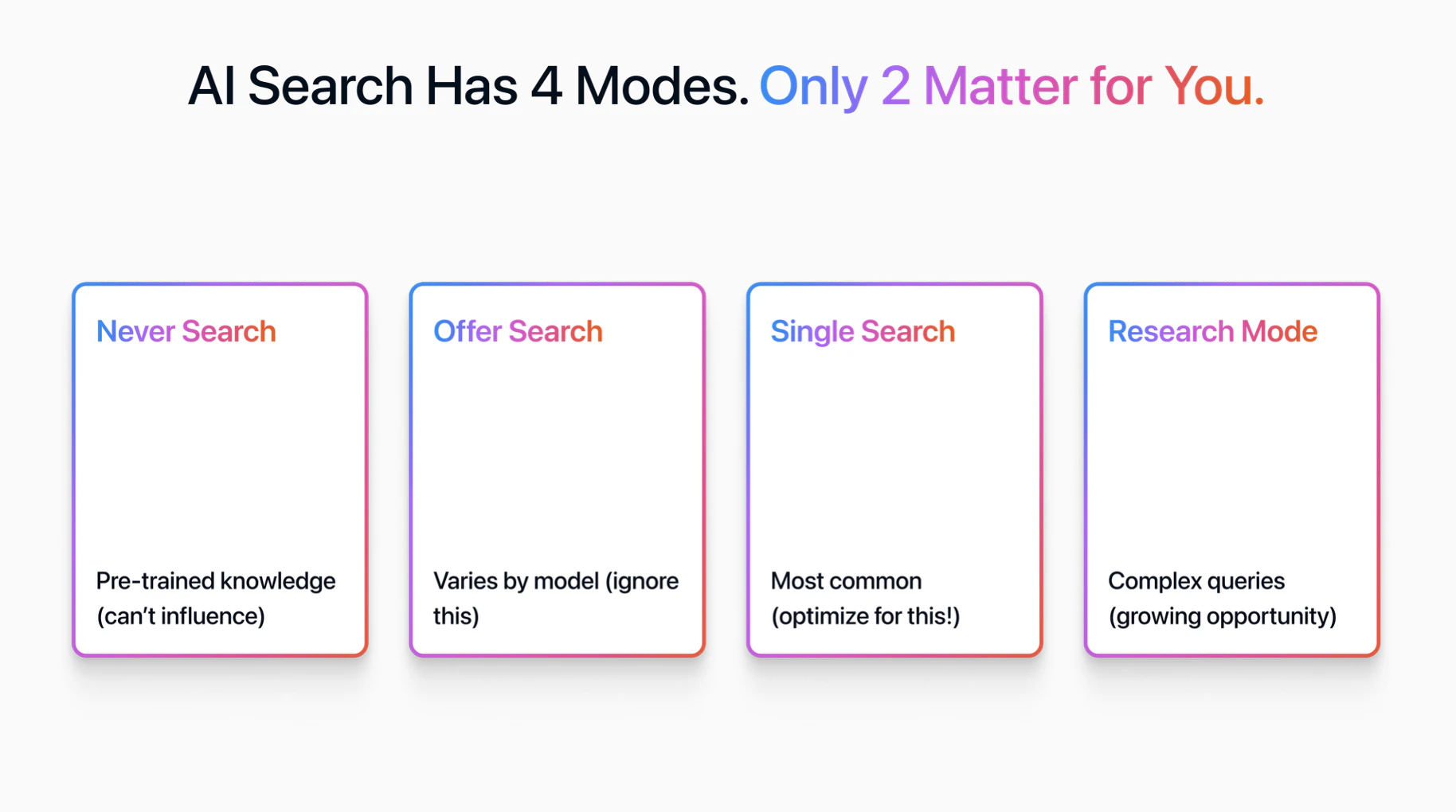 Based on leaked Claude documentation, AI has 4 search modes:
1. **Never Search** - Uses pre-trained knowledge (you can't influence this)
2. **Offer Search** - Varies by model (unpredictable)
3. **Single Search** - Most common, handles 80% of queries (your main opportunity)
4. **Research Mode** - Complex queries needing 2-20 searches (growing opportunity)
Focus your efforts on Single Search and Research Mode - these are where you can actually make an impact.
## What's Different About AI Search
### Key Differences from Traditional SEO
| Aspect | Traditional SEO | AI Search (GEO) |
| ----------------- | ------------------------- | --------------------------- |
| **User Input** | Keywords (2-3 words) | Prompts (15-25 words) |
| **Goal** | Rank in top 10 | Get mentioned at all |
| **Competition** | 10 spots on page 1 | Unlimited mentions possible |
| **Traffic** | Direct clicks | Brand awareness → searches |
| **Updates** | Monthly algorithm changes | Daily volatility |
| **Trust Signals** | Backlinks | Third-party mentions |
**Now that you understand how AI search works differently**, let's learn the new vocabulary you'll need to navigate this world - from prompts to citations and everything in between.
***
What’s Next
* [AI Search Vocabulary & Metrics \[Very Important\]](/docs/ai-search-vocabulary-concepts-very-important)
Based on leaked Claude documentation, AI has 4 search modes:
1. **Never Search** - Uses pre-trained knowledge (you can't influence this)
2. **Offer Search** - Varies by model (unpredictable)
3. **Single Search** - Most common, handles 80% of queries (your main opportunity)
4. **Research Mode** - Complex queries needing 2-20 searches (growing opportunity)
Focus your efforts on Single Search and Research Mode - these are where you can actually make an impact.
## What's Different About AI Search
### Key Differences from Traditional SEO
| Aspect | Traditional SEO | AI Search (GEO) |
| ----------------- | ------------------------- | --------------------------- |
| **User Input** | Keywords (2-3 words) | Prompts (15-25 words) |
| **Goal** | Rank in top 10 | Get mentioned at all |
| **Competition** | 10 spots on page 1 | Unlimited mentions possible |
| **Traffic** | Direct clicks | Brand awareness → searches |
| **Updates** | Monthly algorithm changes | Daily volatility |
| **Trust Signals** | Backlinks | Third-party mentions |
**Now that you understand how AI search works differently**, let's learn the new vocabulary you'll need to navigate this world - from prompts to citations and everything in between.
***
What’s Next
* [AI Search Vocabulary & Metrics \[Very Important\]](/docs/ai-search-vocabulary-concepts-very-important)