> ## Documentation Index
> Fetch the complete documentation index at: https://apidocs.writesonic.com/llms.txt
> Use this file to discover all available pages before exploring further.
# Tag context into a task
> Point a task at a specific playbook, author, audience or source instead of describing it in prose and hoping the agent picks the right one.
A task written entirely in prose leaves the agent to work out which playbook you meant and which voice to write in. Tagging removes the guess. You name the exact object, and it goes into the brief as a reference the agent resolves rather than a phrase it interprets.
## Two ways to tag, and they open the same picker
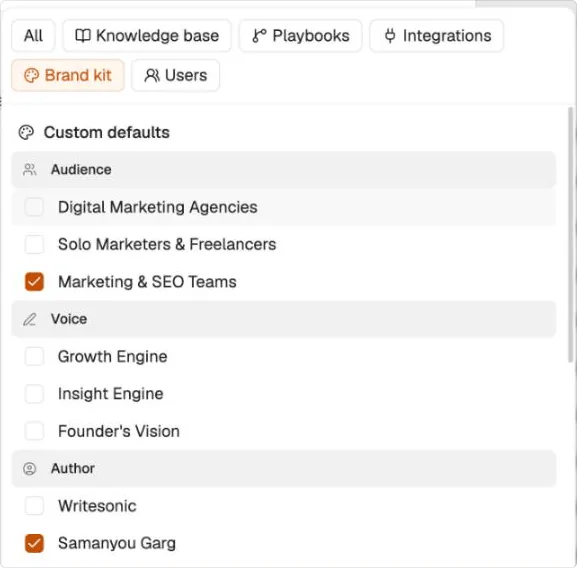
Select **Actions** below the description, or type `@` anywhere in the description itself. Both open the same list, filtered by a row of tabs.
 | Tab | What it holds |
| -------------- | --------------------------------------------------------------- |
| Knowledge base | Every source you've added: URLs and uploaded files |
| Playbooks | Every playbook in the workspace |
| Integrations | Your connected accounts, listed per provider and per connection |
| Brand kit | Your Audience, Voice, Author, Design and Content type entries |
| Users | People in your workspace |
| All | Everything above in one list, grouped by type |
## One playbook per task, as many of everything else as you need
Tag a [playbook](/agents/playbooks) and the task runs those exact steps rather than whatever approach the agent would have chosen. That is how you get a repeatable result out of a system that is otherwise probabilistic: describe the outcome in your own words, then name the playbook that has to produce it.
A task takes one playbook. Tag a second and it replaces the first.
Everything else is multi-select. Two audiences, an author and a content type can all sit in the same brief.
## Brand kit tags decide who it sounds like and who it's for
The [Brand Kit](/agents/set-up-brand-kit) entries are the ones worth reaching for most often, because they answer the questions a brief usually leaves vague.
**Author** sets whose voice it's written in. **Audience** sets who it's written for. **Voice** sets the register. **Content type** sets the shape of the deliverable, so a LinkedIn post and a landing page don't come back looking the same.
Mix them. An article written as one author for one audience is a different piece from the same article written as another.
## Tags sit inline, so write the sentence around them
A tag lands in the description as a chip where your cursor is. Everything else stays plain English.
| Tab | What it holds |
| -------------- | --------------------------------------------------------------- |
| Knowledge base | Every source you've added: URLs and uploaded files |
| Playbooks | Every playbook in the workspace |
| Integrations | Your connected accounts, listed per provider and per connection |
| Brand kit | Your Audience, Voice, Author, Design and Content type entries |
| Users | People in your workspace |
| All | Everything above in one list, grouped by type |
## One playbook per task, as many of everything else as you need
Tag a [playbook](/agents/playbooks) and the task runs those exact steps rather than whatever approach the agent would have chosen. That is how you get a repeatable result out of a system that is otherwise probabilistic: describe the outcome in your own words, then name the playbook that has to produce it.
A task takes one playbook. Tag a second and it replaces the first.
Everything else is multi-select. Two audiences, an author and a content type can all sit in the same brief.
## Brand kit tags decide who it sounds like and who it's for
The [Brand Kit](/agents/set-up-brand-kit) entries are the ones worth reaching for most often, because they answer the questions a brief usually leaves vague.
**Author** sets whose voice it's written in. **Audience** sets who it's written for. **Voice** sets the register. **Content type** sets the shape of the deliverable, so a LinkedIn post and a landing page don't come back looking the same.
Mix them. An article written as one author for one audience is a different piece from the same article written as another.
## Tags sit inline, so write the sentence around them
A tag lands in the description as a chip where your cursor is. Everything else stays plain English.
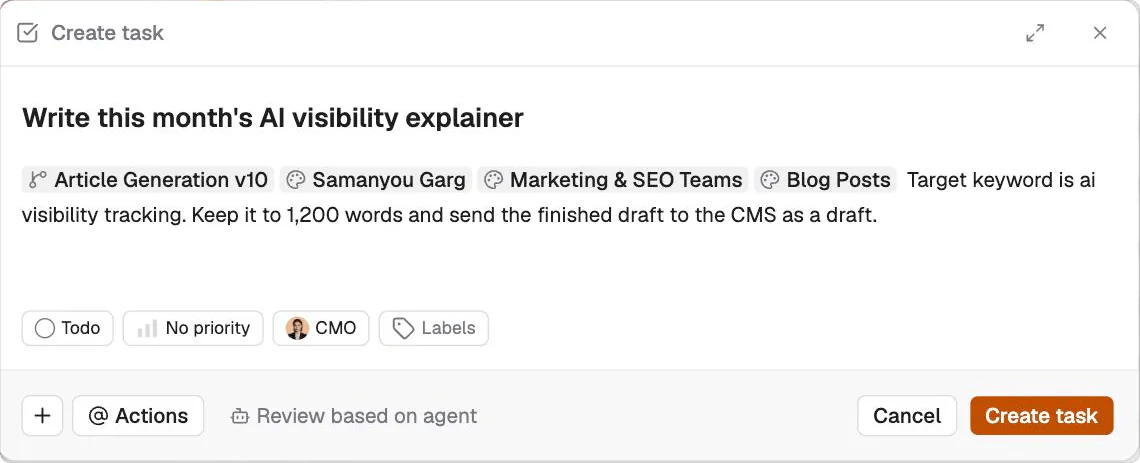 Tag the things that have an exact answer and write the rest normally. The word count, the target keyword and where the draft should land are all better as a sentence than as a tag.
Closing the modal offers **Save to draft**, so a half-composed brief keeps its tags until you come back.
## What's next
What to put in the prose around the tags.
Set up the authors, audiences and voices you'll tag.
Tag the things that have an exact answer and write the rest normally. The word count, the target keyword and where the draft should land are all better as a sentence than as a tag.
Closing the modal offers **Save to draft**, so a half-composed brief keeps its tags until you come back.
## What's next
What to put in the prose around the tags.
Set up the authors, audiences and voices you'll tag.