> ## Documentation Index
> Fetch the complete documentation index at: https://apidocs.writesonic.com/llms.txt
> Use this file to discover all available pages before exploring further.
# Page detail
> Inspect one page across five evidence tabs, then turn its named opportunities into a reviewed agent task.
Open **Pages > Page details** to investigate a single page. The header shows its title with a link to the live URL, the selected market such as US, and a date range compared with the previous period.
The right-hand Details panel keeps Type, Target keyword, Word count, Published, Last updated, First seen, Index status, and Search intent visible as you move between tabs. BIP is a prioritisation aid that is still being built out.
## Overview names the work worth doing
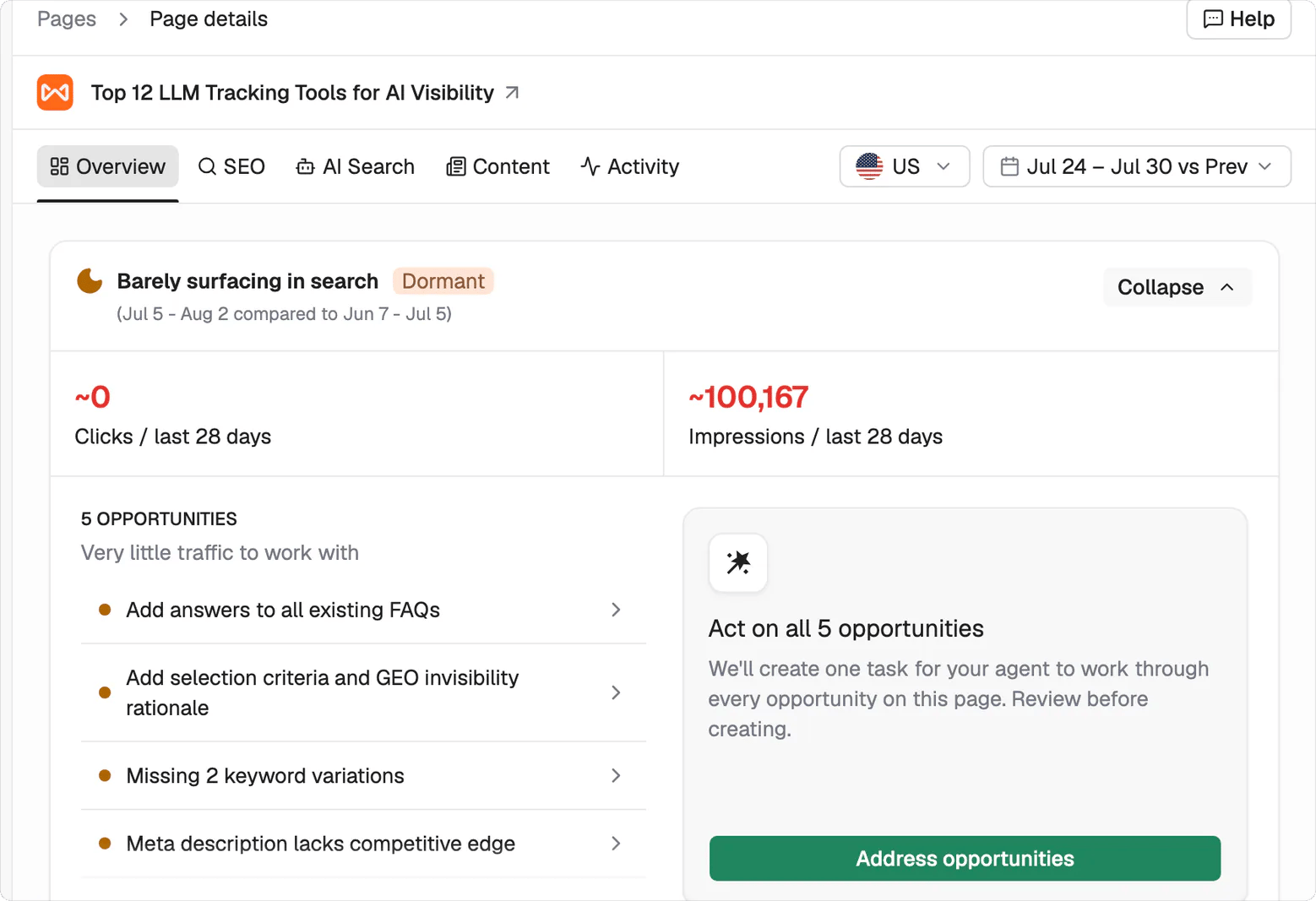
Overview opens with a plain-language status such as "Barely surfacing in search", a Dormant badge, and the compared window. It then shows clicks and impressions for the last 28 days. A real page with about 0 clicks and 100,167 impressions is captioned "Very little traffic to work with".
Below that diagnosis, **named opportunities** turn the gaps into concrete work:
1. Add answers to all existing FAQs
2. Add selection criteria and GEO invisibility rationale
3. Missing 2 keyword variations
4. Meta description lacks competitive edge
5. Page missing structured data
A card beside the list explains what the button will do:
> Act on all 5 opportunities. We'll create one task for your agent to work through every opportunity on this page. Review before creating.
Select **Address opportunities** after reviewing the list. The CMO agent receives one task and splits it into subtasks. Nothing publishes on its own, and any CMS work lands as a draft.
 ## SEO separates search performance from the results page
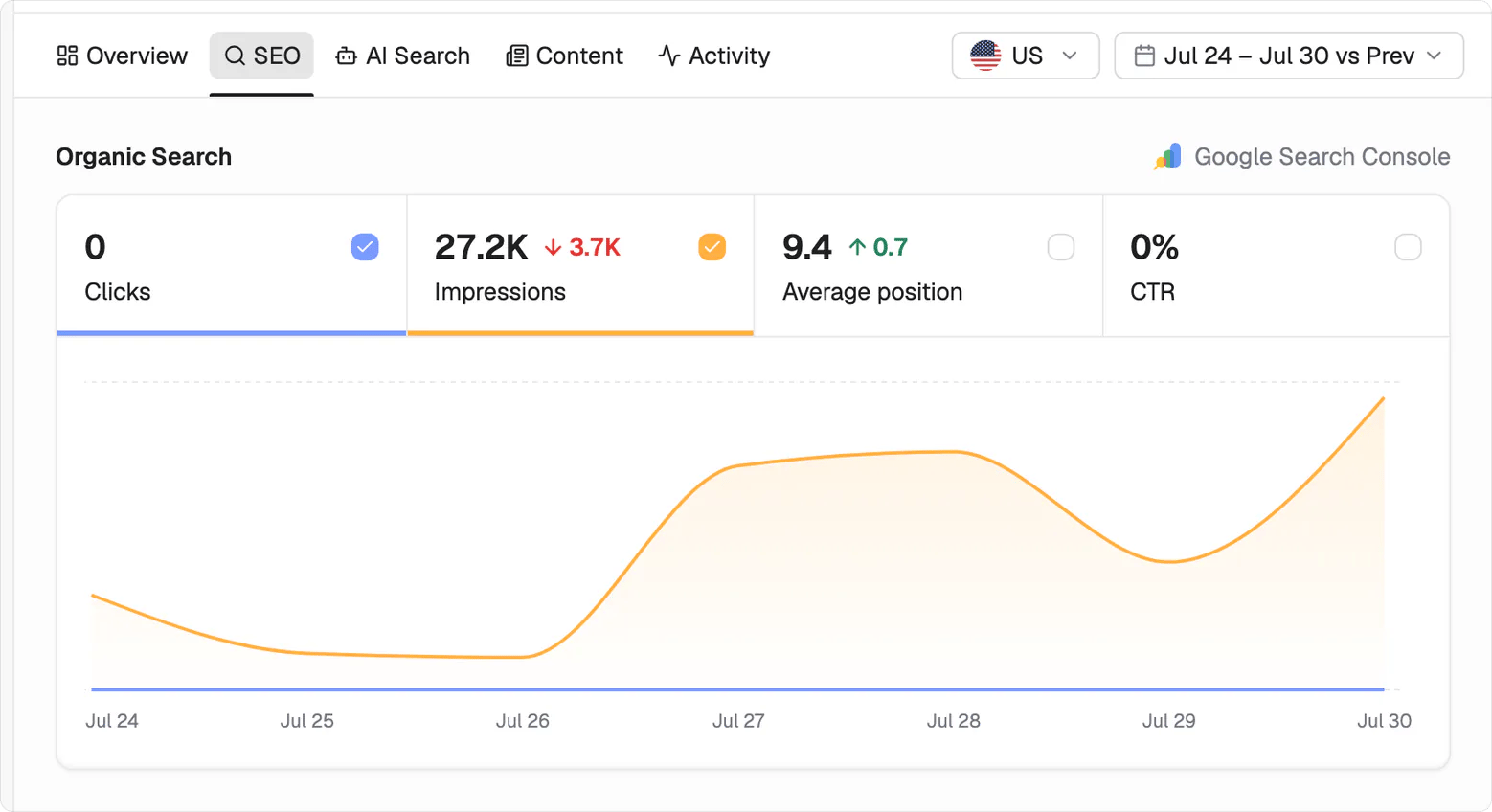
The **Organic Search** section attributes its data to Google Search Console. Clicks, Impressions, Average position, and CTR are toggleable metrics plotted on the same chart, so you can change the view without losing the shared date range.
**Marketing Traffic** sits below it and identifies Plausible or GA4 as its source.
SERP Intelligence explains the search environment around the page. It records search intent, gives a written read of what is ranking, and shows which SERP features were captured out of four: featured snippet, People Also Ask, related searches, and knowledge graph. Your position appears beside the organic competitors ranking above you.
## SEO separates search performance from the results page
The **Organic Search** section attributes its data to Google Search Console. Clicks, Impressions, Average position, and CTR are toggleable metrics plotted on the same chart, so you can change the view without losing the shared date range.
**Marketing Traffic** sits below it and identifies Plausible or GA4 as its source.
SERP Intelligence explains the search environment around the page. It records search intent, gives a written read of what is ranking, and shows which SERP features were captured out of four: featured snippet, People Also Ask, related searches, and knowledge graph. Your position appears beside the organic competitors ranking above you.
 ## AI Search connects visits and citations to their source
The **AI Search** tab separates bot visits from human visits and breaks the bot traffic out by platform. This shows which platforms are reaching the page without folding their activity into human traffic.
Citations provide the other half of the view. You can slice them by prompt, platform, and topic to see where the page is being used in AI answers and where it remains absent.
## Content shows the inputs behind its score
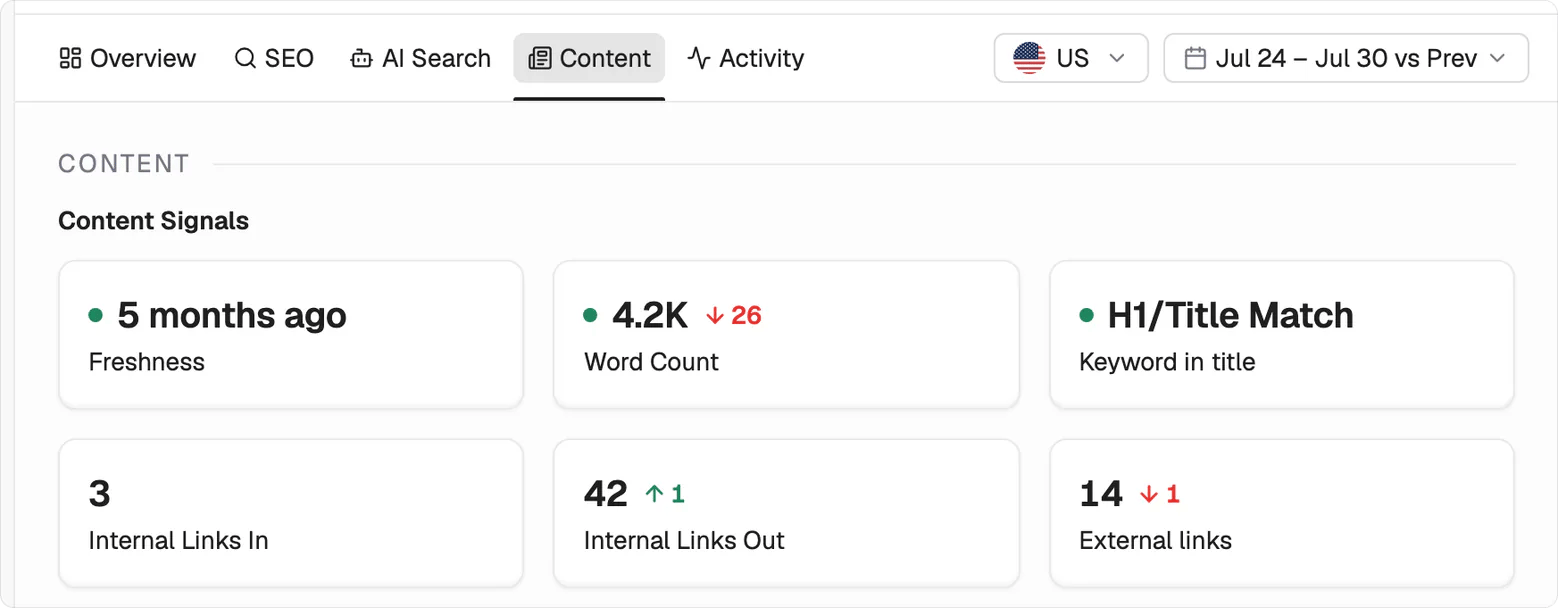
The **Content Signals** band gives you six page-level readings before the score:
| Signal | Example reading |
| ------------------ | ---------------- |
| Freshness | 5 months ago |
| Word Count | 4.2K |
| H1/Title Match | Keyword in title |
| Internal Links In | 3 |
| Internal Links Out | 42 |
| External links | 14 |
Below the band, Content Score grades the page out of 100 and assigns a label such as Excellent. Nine weighted signals contribute to it: Schema 15%, E-E-A-T 15%, Structure 12%, Internal Links 12%, Information Gain 10%, Keyword Alignment 10%, Readability 10%, Non-Commodity 8%, and Freshness 8%.
Coming soon. Per-signal breakdown is not available yet.
## AI Search connects visits and citations to their source
The **AI Search** tab separates bot visits from human visits and breaks the bot traffic out by platform. This shows which platforms are reaching the page without folding their activity into human traffic.
Citations provide the other half of the view. You can slice them by prompt, platform, and topic to see where the page is being used in AI answers and where it remains absent.
## Content shows the inputs behind its score
The **Content Signals** band gives you six page-level readings before the score:
| Signal | Example reading |
| ------------------ | ---------------- |
| Freshness | 5 months ago |
| Word Count | 4.2K |
| H1/Title Match | Keyword in title |
| Internal Links In | 3 |
| Internal Links Out | 42 |
| External links | 14 |
Below the band, Content Score grades the page out of 100 and assigns a label such as Excellent. Nine weighted signals contribute to it: Schema 15%, E-E-A-T 15%, Structure 12%, Internal Links 12%, Information Gain 10%, Keyword Alignment 10%, Readability 10%, Non-Commodity 8%, and Freshness 8%.
Coming soon. Per-signal breakdown is not available yet.
 ## Activity keeps the page's history in one place
The **Activity** tab shows this page's own history, with the wider record covered in the [Activity log](/agents/activity-log).
## What's next
See what happens after you press Address opportunities.
Check the record used to prove the change worked.
## Activity keeps the page's history in one place
The **Activity** tab shows this page's own history, with the wider record covered in the [Activity log](/agents/activity-log).
## What's next
See what happens after you press Address opportunities.
Check the record used to prove the change worked.